Arras: A Playful Display Typeface for Handmade Creators
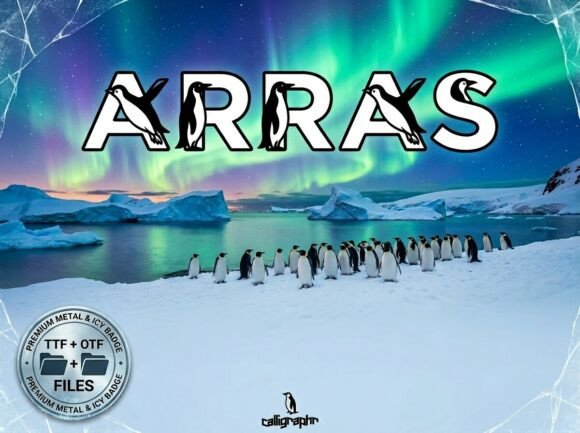
I was halfway through designing a set of winter candle labels—frosted glass jars, creamy soy wax, soft linen tags—when I realized my usual go-to fonts felt too safe. Too quiet. I needed something that whispered “cozy celebration” but shouted “look at me!” That’s when I opened Arras. Instantly, the bold, rounded letterforms caught my eye—not just for their shape, but for their soul. There’s a gentle rhythm in every curve, a subtle bounce in the baseline, and those delightful hand-drawn penguin silhouettes tucked into the letterforms? Pure magic. Arras isn’t just a decorative font—it’s a mood, a moment, a tiny spark of personality you can print, cut, or stitch right onto your handmade goods.
As a maker who designs everything from printable planner pages to boutique packaging, I reach for Arras when I want warmth with intention. It’s a display typeface—meaning it shines brightest at larger sizes and shorter text. Think product names on apothecary-style candle labels (“Frostbite Vanilla,” “Polar Mint”), greeting card headlines (“You’re Paws-itively Amazing!”), or welcome signs for cozy wedding setups. Its playful yet polished energy bridges rustic charm and modern minimalism—perfect for farmhouse markets, holiday pop-ups, or digital shop banners that need to stand out in a scroll.
What makes Arras especially useful for physical products is its built-in readability—even at small scales. I tested it on ¾-inch sticker sheets for gift tags: the rounded terminals and generous counters kept letters legible after cutting (no ghosting or clipped curves on my Cricut). On matte-finish kraft paper labels? Crisp. On glossy mug decals? Confident. For tote bags printed with water-based ink? The weight holds beautifully without bleeding. Just remember: Arras is designed for impact, not paragraphs. Skip using it for ingredient lists, care instructions, or full invitation copy—but absolutely lean in for titles, monograms, seasonal slogans (“Snow Day Approved”), or brand names stamped on cotton drawstring bags.
I’ve used Arras across so many real production moments: sketching mockups for a spring planner bundle (paired with a light sans serif for body text), prepping SVG files for vinyl-cut boutique tags, laying out printable wall art for nursery themes, and even drafting social media graphics for a local candle shop’s “Penguin & Pine” holiday collection. Each time, it added instant character—without feeling gimmicky. That’s the quiet power of a well-designed decorative font: it doesn’t shout over your product; it invites people closer to it.
Pairing Arras thoughtfully matters. For clean contrast, I often layer it with a neutral sans serif like Montserrat or Inter—ideal for labels where the brand name (in Arras) sits above smaller details (in the sans). When designing wedding stationery, I’ll combine Arras headlines with a delicate script font for names or dates—creating hierarchy while keeping things tender and personal. And for digital printables like birthday party kits or classroom posters? A simple serif like Merriweather in regular weight balances Arras’ bounciness without competing. The key is contrast: weight, style, and purpose—not matching.
Before diving in, I always check what’s included in the Arras font family. Does it have alternate characters? (Yes—some letters offer playful variations.) Are there ligatures or swashes? (A few charming ones, great for customizing “love,” “joy,” or “hello.”) What file formats are provided? (OTF and TTF—both work smoothly in Canva, Silhouette Studio, and Adobe apps.) Most importantly: does the license cover commercial use? Yes—it’s a premium font built for makers who sell physical products, digital templates, SVG bundles, or merchandise. That means you can confidently use Arras on Etsy listing previews, printable wall art PDFs, or the front of a limited-run t-shirt—no legal second-guessing.
Real talk: not every font earns a permanent spot in my design toolkit. But Arras has. It’s become my “joy font”—the one I open when I want a project to feel lighter, kinder, more human. Whether I’m laser-cutting wooden ornaments with Arras-engraved phrases, designing printable baby shower banners, or mocking up a new line of ceramic mugs with minimalist polar-themed slogans, this typeface adds consistent charm without sacrificing clarity. It supports multilingual characters too, which came in handy when adapting a set of planner stickers for bilingual clients.
One final note: if you're using Arras for cutting machines, preview at 100% scale before sending to your Silhouette or Cricut. Some penguin-inspired glyphs (like the lowercase ‘a’ or ‘g’) carry extra detail—beautiful at 24pt+, but best simplified for sub-¼-inch applications. For tiny stickers or embroidered patches, stick to the standard characters—they’re optimized for crisp output. And always test print a label or card first: ink absorption, paper texture, and screen brightness can shift how rounded edges appear.
At its heart, Arras is more than a decorative font—it’s a creative collaborator. It doesn’t ask you to change your process; it simply lifts what you already make with warmth, wit, and quiet confidence. Whether you're handwriting invitations, designing digital downloads, or pressing foil onto kraft boxes, Arras meets your handmade ethos with sincerity—and a little penguin flair.